
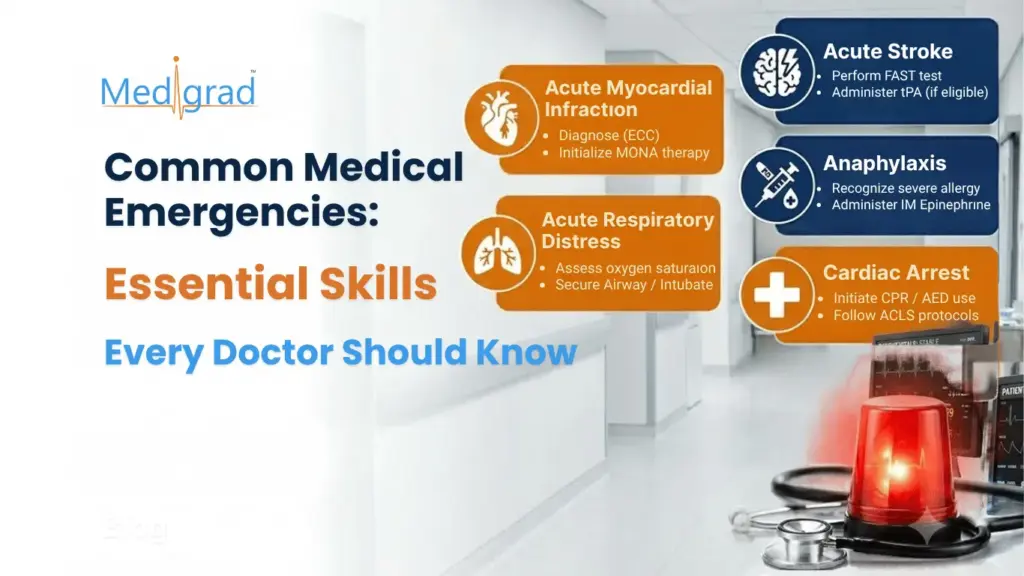
Medical emergencies can occur in hospitals, emergency departments, outpatient clinics and other clinical settings. Effective medical emergency management involves more than diagnosing. Doctors need to recognize deterioration, assess immediate threats, prioritize care, communicate with the healthcare team and escalate appropriately.
For MBBS doctors and practicing physicians, developing emergency medicine skills can strengthen their ability to respond to acute and potentially life-threatening situations.
Clinical note: This blog is for educational purposes. Emergency assessment and management should follow current clinical guidelines, institutional protocols, available resources and the doctor’s training and scope of practice.
What Is Medical Emergency Management?
Medical emergency management is the structured process of rapidly assessing a patient, identifying immediate threats, initiating appropriate care, monitoring the response and arranging further treatment or escalation.
A commonly used framework is the ABCDE approach:
- A – Airway
- B – Breathing
- C – Circulation
- D – Disability
- E – Exposure
ABCDE provides a structured way to identify immediate physiological problems while further diagnostic assessment continues. Reassessment and timely escalation are also important components of emergency care.
6 Common Medical Emergencies Every Doctor Should Know
1. Cardiac Arrest
Cardiac arrest is one of the most time-critical emergencies a doctor may encounter. Rapid recognition and coordinated action are essential.
Doctors should be familiar with:
- Recognizing an unresponsive patient who is not breathing normally
- Basic life support and resuscitation
- Appropriate use of an AED or defibrillator
- Effective team communication
- Continuous reassessment during resuscitation
Essential skill: Rapid recognition and coordinated resuscitation.
2. Acute Coronary Syndrome
Acute coronary syndrome (ACS) includes serious conditions associated with acute myocardial ischemia. Presentations can include chest discomfort, breathlessness, sweating, nausea and other symptoms.
Doctors should be prepared to:
- Assess potentially serious chest pain promptly
- Review relevant history and risk factors
- Perform appropriate initial assessment and investigations
- Recognize clinical deterioration
- Arrange timely emergency or specialist referral
Essential skill: Rapid cardiovascular assessment and clinical decision-making.
3. Acute Stroke
Stroke is a time-sensitive neurological emergency. Sudden facial weakness, limb weakness, speech difficulty, visual changes or other neurological abnormalities should prompt urgent assessment.
Emergency management involves:
- Recognizing sudden neurological changes
- Assessing immediate physiological stability
- Considering stroke and other possible causes of deterioration
- Initiating the appropriate emergency pathway
- Escalating promptly for specialist assessment
Essential skill: Early recognition of neurological deterioration.
4. Anaphylaxis
Anaphylaxis is a potentially life-threatening allergic reaction that can rapidly affect the airway, breathing and circulation.
Warning signs may include:
- Airway swelling or compromise
- Breathing difficulty or wheezing
- Hypotension
- Circulatory compromise
- Rapid deterioration following possible allergen exposure
Doctors should recognize the emergency promptly, activate appropriate support and follow current anaphylaxis protocols.
Essential skill: Rapid assessment of airway, breathing and circulation.
5. Sepsis and Shock
Sepsis and shock can result in rapid physiological deterioration. Patients may present with infection, abnormal vital signs, altered mental status or signs of impaired perfusion.
Doctors should focus on:
- Early recognition of deterioration
- Structured ABCDE assessment
- Assessment of circulation and perfusion
- Identifying a possible source of infection
- Monitoring and reassessment
- Timely escalation when required
Essential skill: Recognizing deterioration and potential shock early.
6. Acute Respiratory Distress
Acute respiratory distress can occur with conditions such as severe asthma, pneumonia, pulmonary edema, pulmonary embolism and other cardiopulmonary emergencies.
Warning signs may include:
- Increasing work of breathing
- Abnormal respiratory rate
- Low oxygen saturation
- Cyanosis
- Difficulty speaking because of breathlessness
- Altered mental status
Doctors should rapidly assess airway and breathing, recognize deterioration and arrange appropriate escalation.
Essential skill: Rapid respiratory assessment and recognition of deterioration.
Essential Emergency Medicine Skills Every Doctor Should Develop
Knowing common emergencies is only one part of effective emergency care. Doctors also need transferable skills that can be applied across different acute presentations.
1. Rapid Decision-Making
Emergencies often require decisions based on incomplete information. Doctors need to identify immediate threats, prioritize problems and determine when additional expertise or resources are required.
2. ABCDE Assessment
A structured ABCDE assessment helps doctors systematically evaluate airway, breathing, circulation, neurological status and other important findings while avoiding delays in addressing immediate threats.
3. Triage and Prioritization
Doctors need to distinguish patients who require immediate intervention from those who can safely undergo further assessment. Triage and prioritization are particularly important when multiple patients require care simultaneously.
4. Resuscitation Skills
Understanding basic life support, resuscitation principles and the appropriate use of emergency equipment is fundamental to responding to life-threatening deterioration.
5. Procedural and Practical Skills
Depending on their role, training and clinical setting, doctors may need familiarity with emergency equipment, patient monitoring, airway support, vascular access, resuscitation equipment and other acute-care procedures.
6. Communication and Teamwork
Emergency care is highly team-based. Clear communication during handovers, appropriate delegation, coordination with nurses and specialists, and timely escalation can support safer emergency responses.
7. Monitoring and Reassessment
A patient’s condition can change rapidly. Emergency management therefore requires ongoing monitoring, reassessment after interventions and recognition when the initial approach needs to change.
8. Stress and Time Management
Emergency environments can involve time pressure, uncertainty and multiple competing priorities. Doctors need to remain structured, communicate clearly and maintain clinical judgment under pressure.
How Doctors Can Build Emergency Medicine Skills Through Medigrad Fellowships
Medigrad offers fellowship pathways that can support doctors looking to develop these competencies after MBBS, depending on their qualifications, experience and career goals.
- Fellowship in Emergency Medicine: A structured pathway covering emergency and acute-care concepts, with academic learning and hospital-based training to support the development of practical emergency medicine skills.
- Clinical Fellowship in Emergency Medicine: A full-time clinical training pathway for eligible doctors seeking focused clinical exposure and hands-on learning in emergency medicine.
- Fellowship in Critical Care Medicine: Relevant for doctors interested in critically ill patients and skills related to stabilization, recognition of deterioration, resuscitation and critical-care management.
When choosing a fellowship, doctors should consider eligibility, curriculum, duration, learning format, clinical or hospital exposure and how closely the program aligns with their intended area of practice. A structured fellowship can help connect theoretical knowledge with the clinical skills needed to respond more effectively to acute and emergencies.
Frequently Asked Questions
What is medical emergency management?
Medical emergency management is the rapid assessment, stabilization, monitoring and escalation of patients with potentially life-threatening illness or injury.
What are the most common medical emergencies doctors should know?
Common emergencies include cardiac arrest, acute coronary syndrome, stroke, anaphylaxis, sepsis and shock, and acute respiratory distress along with
What emergency medicine skills should every doctor develop?
Important skills include ABCDE assessment, triage, resuscitation, recognition of deterioration, emergency decision-making, communication, teamwork, monitoring and appropriate escalation.
Why is ABCDE important in emergency medicine?
ABCDE provides a structured approach for identifying immediate problems involving the airway, breathing, circulation, neurological status and other important findings.
Can MBBS doctors develop emergency medicine skills?
Yes. Depending on eligibility and career goals, MBBS doctors can develop emergency-care skills through continuing education, emergency medicine courses, simulation, supervised clinical training and structured fellowship programs.
What should doctors consider when choosing an emergency medicine course or fellowship?
Doctors should consider eligibility, curriculum, duration, learning format, practical or hospital training, faculty, certification or accreditation information and relevance to their intended career pathway.

