
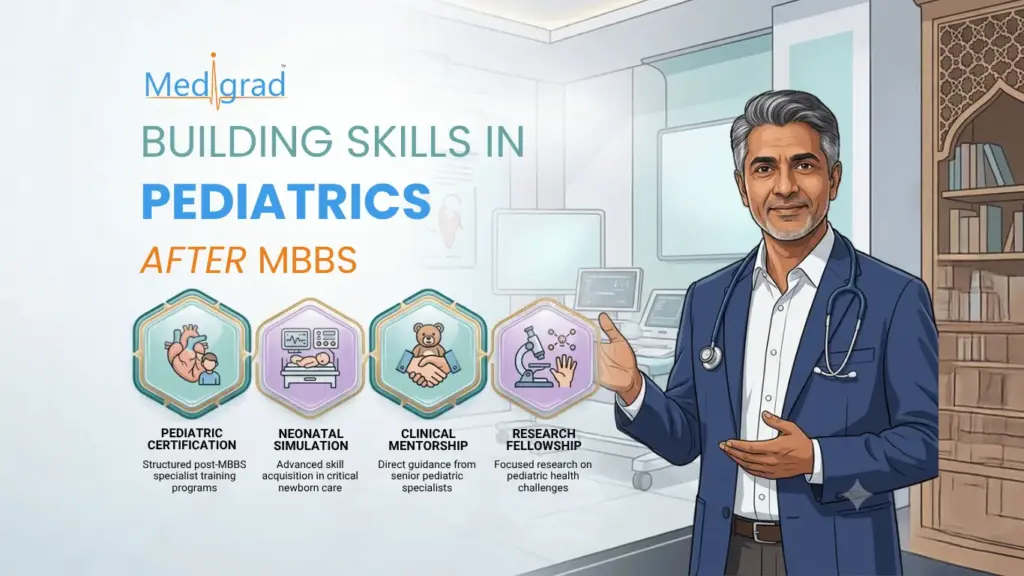
Completing MBBS provides doctors with a broad medical foundation. Some doctors may then want to develop more focused knowledge in a specific clinical area, such as pediatrics, through pediatric education and practical learning.
For doctors interested in child healthcare, there are different ways to continue learning after MBBS. These include clinical experience, continuing medical education, structured courses, and fellowship in pediatrics, depending on the doctor’s qualifications, professional requirements, and career goals.
Why Is Pediatric Education Important After MBBS?
MBBS gives doctors a broad foundation in medicine, while some doctors may want to develop more focused knowledge in pediatrics. Working with infants, children and adolescents involves understanding areas such as growth and development, nutrition, immunization, common childhood illnesses, neonatal care and pediatric emergencies.
Pediatric education in these areas can help doctors strengthen their understanding of pediatric assessment and care. For doctors interested in developing focused knowledge in pediatrics, structured learning through relevant courses, clinical experience or fellowship programs can provide a systematic way to continue their medical education after MBBS.
What Can MBBS Doctors Do to Develop Skills in Pediatrics?
1. Gain Relevant Clinical Experience
Clinical experience can help doctors understand how pediatric patients are assessed and managed in real healthcare settings.
Exposure to pediatric units can complement theoretical learning by allowing doctors to observe clinical workflows, patient assessment and case management under appropriate supervision.
2. Continue With Structured Medical Education
Doctors can use continuing medical education and courses in pediatrics to strengthen their knowledge in specific areas of child healthcare.
A structured program can be particularly useful when a doctor wants to study several interconnected topics, such as child development, infectious diseases, nutrition, neonatology and pediatric emergencies, within a defined curriculum.
3. Develop Knowledge Through Case-Based Learning
Pediatric care involves applying medical knowledge to individual patient presentations. Learning through real-life case scenarios can help doctors develop clinical reasoning and problem-solving skills.
Case-based learning can complement lectures and study material by allowing doctors to consider how different pediatric conditions may present and how they can be approached clinically.
4. Consider a Pediatrics Fellowship
Eligible MBBS doctors who want a longer, structured learning pathway can consider a fellowship in pediatrics. Doctors looking for more information about this type of learning pathway can also explore why doctors choose a pediatrics fellowship.
How Does Practical Learning Support Pediatric Education?
Learning pediatrics is not limited to reading about conditions and treatment approaches. Seeing how children are assessed and managed in a clinical setting can help doctors connect what they study with real patient situations.
Medigrad’s Fellowship in Pediatrics is a 12-month program with four weeks of training at partnered hospitals. The program is designed for MBBS doctors and focuses on pediatric health, nutrition and neonatology care.
Who Is the Program Mentor?
The Medigrad Fellowship in Pediatrics is led by Dr. Ashutosh Aggarwal, who has a background in pediatrics and neonatology. His academic and professional qualifications include MBBS, postgraduate training in Pediatrics, an MD from PGIMS, a PGD in Adolescent Health from Annamalai University and a Fellowship in Neonatology from Singapore.
He also brings 15 years of clinical experience across hospitals in North India and 12 years of teaching experience in medical and postgraduate education across India.
Frequently Asked Questions
What can I study in pediatrics after MBBS?
After MBBS, doctors interested in pediatrics can build knowledge in areas such as child growth and development, neonatology, nutrition, immunization, infectious diseases, respiratory conditions, pediatric emergencies and other common childhood conditions.
Can MBBS doctors study pediatrics without doing MD Pediatrics?
Yes, doctors can pursue additional learning in pediatrics through courses, continuing medical education and other structured programs. However, these options should not be confused with formal postgraduate qualifications such as MD or DNB in Pediatrics.
What are the options to study pediatrics after MBBS?
The appropriate option depends on what a doctor wants to learn. Doctors may compare short courses, focused certifications, clinical learning opportunities and longer structured fellowship programs based on the curriculum, practical exposure, duration and their professional goals.
How can I improve my pediatric knowledge after MBBS?
Doctors can improve their pediatric knowledge through relevant clinical exposure, continuing medical education, structured study and case-based learning. A longer program can also provide a systematic way to study different areas of pediatrics rather than learning individual topics separately.
Is there an online pediatrics course for MBBS doctors?
Yes, online and blended pediatric education programs are available for doctors at Medigrad. When considering one, doctors should check what is taught online and whether the program also provides any practical or hospital-based learning.

