
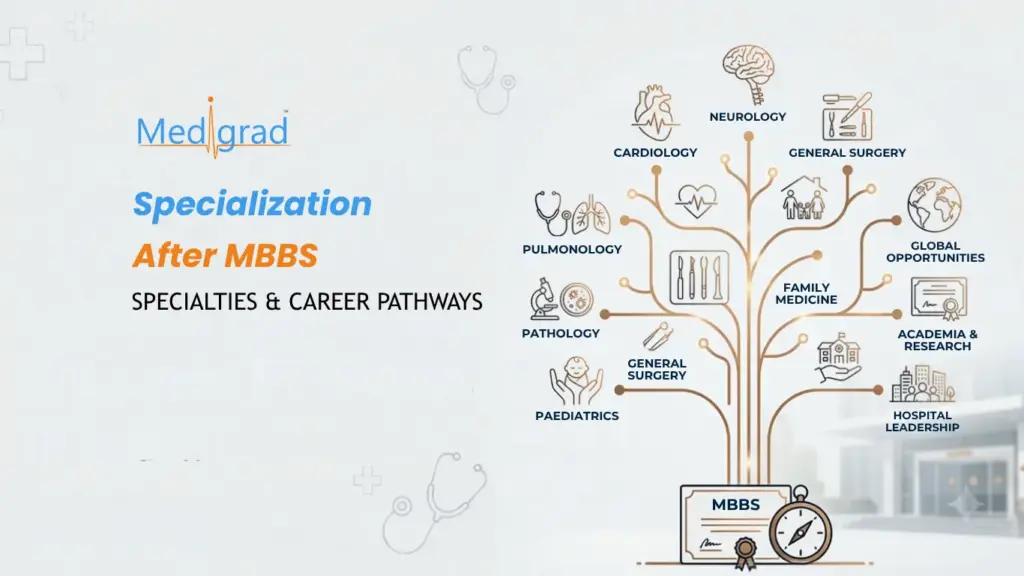
Completing MBBS gives doctors a broad foundation in medicine, but many doctors choose further training to develop expertise in a specific clinical field. If you are considering specialization after MBBS, an important first step is understanding the difference between recognized postgraduate qualifications and additional educational programs such as fellowships or certificates.
In India, postgraduate medical education includes recognized MD, MS and DNB pathways, with specialty options covering medical, surgical and other clinical disciplines. The National Medical Commission’s postgraduate medical education framework includes recognized broad-specialty qualifications such as MD Family Medicine and MD General Medicine. (Rules and Regulations, NMC)
What Are the Options for Specialization After MBBS?
For an MBBS doctor, specialization can involve different types of postgraduate and additional educational pathways.
The major postgraduate routes include:
- MD (Doctor of Medicine) for various medical specialties
- MS (Master of Surgery) for surgical specialties
- DNB programs under the National Board framework
- Super-specialty training after an eligible postgraduate qualification, where applicable
Medical Specialties to Consider After MBBS
The specialty you consider depends on the type of clinical work you want to do, the patients you want to treat and the practice setting you prefer.
General Medicine
General Medicine focuses primarily on adult medical care, including diagnosis and management of acute, chronic and multisystem conditions. It can also provide a pathway toward further specialization in selected areas.
Family Medicine
Family Medicine focuses on comprehensive and continuing healthcare across age groups. It includes primary care, prevention, chronic disease management and coordination of care across different clinical needs.
Emergency Medicine
Emergency Medicine focuses on the assessment and initial management of acute illnesses, injuries and other medical emergencies, often requiring rapid decision-making and stabilization.
Pediatrics
Pediatrics focuses on the health and medical care of infants, children and adolescents.
Obstetrics and Genecology
This field focuses on women’s reproductive health, pregnancy, childbirth and related clinical care.
Doctors may also consider specialties such as Respiratory Medicine, Pathology, Community Medicine, General Surgery and Orthopedics, along with other recognized postgraduate disciplines, depending on their interests and eligibility.
The availability of seats, eligibility requirements and admission processes can vary by specialty and institution.
How Do You Choose a Specialization After MBBS?
Choosing a specialty involves more than looking at the name of the course. Consider the type of medicine you want to practice every day.
Ask yourself:
- Do I prefer adult medicine, children’s healthcare or care across age groups?
- Do I enjoy diagnosis, procedures, surgery or long-term patient care?
- Would I prefer a hospital, outpatient or community-based setting?
- Am I interested in acute care or chronic disease management?
- Do I want opportunities for further specialty training?
- What qualification and training structure am I looking for?
Your preferred clinical role, training requirements and long-term career plans can help narrow the options.
Additional Clinical Learning and Fellowships After MBBS
For doctors looking to build focused clinical knowledge and practical skills after MBBS, fellowships can be an additional learning pathway alongside or outside a formal postgraduate route.
Fellowships can be relevant for doctors interested in areas such as Family Medicine, Internal Medicine, Diabetology, Preventive Cardiology, Critical Care Medicine, and Emergency Medicine, depending on the eligibility, curriculum and training structure of the individual program.
Medigrad offers fellowship and certification programs designed around focused clinical learning, with the format varying by discipline. Depending on the individual program, learning may include online education, live academic sessions, practical training or hospital-based clinical exposure. This allows doctors to pursue structured learning in an area that aligns with their clinical interests and intended practice.
Hospital-based training can also provide opportunities to work in a clinical environment, interact with other doctors and healthcare professionals, and build professional connections. These experiences can help doctors expand their clinical knowledge, gain greater familiarity with different approaches to patient care, and develop a professional network within their area of interest.
A fellowship may also support career development and earning potential when the additional knowledge, skills and clinical experience help a doctor take on relevant roles or responsibilities. However, completing a fellowship does not guarantee a salary increase. Earning potential can vary based on factors such as experience, employer, location, role, skills and the type of fellowship completed.
Overall, a fellowship can provide an additional opportunity for doctors to continue their professional development after MBBS while building focused clinical knowledge, practical experience and professional connections.
Fellowship vs MD/MS/DNB After MBBS: Understanding the Difference
Understanding this difference can help doctors choose a program that matches what they want to achieve—whether that is pursuing a formal postgraduate specialty qualification or developing focused clinical knowledge and skills through a fellowship.
| Aspect | MD / MS / DNB | Medigrad Fellowship |
| Primary purpose | Formal postgraduate specialization | Focused clinical education and additional skill development |
| Learning focus | Comprehensive training in a recognized specialty | Specialty-focused learning in a selected clinical area |
| Program structure | Governed by the applicable postgraduate medical education framework | Structured according to the individual Medigrad program |
| Learning format | Structured postgraduate training | Online or blended learning, with practical/hospital training where applicable |
| Clinical exposure | Formal postgraduate clinical training | Practical or hospital-based training where included in the individual program |
| Duration | Determined by the postgraduate qualification | Varies by program; Medigrad programs include different durations depending on the specialty |
| Eligibility | Subject to applicable postgraduate admission requirements | Depends on the eligibility requirements of the individual program |
| Qualification awarded | MD, MS or DNB, as applicable | Medigrad fellowship or certificate, according to the program |
Frequently Asked Questions About Specialization After MBBS
- What are the options for specialization after MBBS?
After MBBS, doctors can pursue formal postgraduate qualifications such as MD, MS, or DNB, depending on their eligibility and the applicable admission pathway. Doctors may also consider fellowships, certificate programs, and other forms of focused clinical education to develop additional knowledge and skills in a particular area.
- Which medical specialties can doctors pursue after MBBS?
Doctors can choose from a range of clinical and non-clinical postgraduate disciplines depending on the available qualifications and eligibility requirements. Clinical options include areas such as General Medicine, Family Medicine, Pediatrics, Psychiatry, Dermatology, Anaesthesiology, Radiodiagnosis, General Surgery, Orthopaedics, and Obstetrics & Gynaecology, among others.
- Is NEET-PG required for specialization after MBBS?
For many formal postgraduate medical admissions in India, NEET-PG is the relevant national entrance examination, subject to the applicable admission rules and the specific qualification or institution. Doctors should check the latest official NBEMS and counselling notifications for the year in which they intend to apply.
- What is the difference between MD, MS and DNB after MBBS?
MD and MS are postgraduate medical degrees in different disciplines, while DNB is a postgraduate qualification awarded through the National Board route. The appropriate choice depends on the specialty, eligibility, admission pathway, training institution and long-term career plans.
- How should I choose a specialization after MBBS?
Consider your clinical interests, preferred patient population, type of clinical work, training requirements, long-term career goals and eligibility for the relevant postgraduate pathways. It can also be useful to understand the day-to-day practice and clinical exposure associated with a specialty before making a decision.
- Should I choose postgraduate specialization or a fellowship after MBBS?
It depends on your career goals. For MBBS doctors who want to strengthen their knowledge and clinical skills in areas such as Family Medicine, Internal Medicine, Diabetology, Critical Care Medicine, or Emergency Medicine, a fellowship can provide structured learning and, depending on the program, practical or hospital-based exposure.

