
Choosing a medical fellowship after MBBS involves more than comparing specialty, duration, or course fees. Accreditation is an important indicator of educational quality because it reflects whether a program has been developed within a structured educational framework. This guide explains what AACME accreditation is, why it matters for MBBS doctors, and how it can help you choose the right fellowship.
Among internationally recognized educational quality frameworks, the American Association of Continuing Medical Education (AACME) promotes structured, evidence-informed learning that encourages doctors to update their clinical knowledge and skills throughout their careers.
Understanding AACME accreditation for MBBS doctors can help you evaluate fellowship programs, see our Medical Course Accreditation page.
Who Should Consider an AACME-Accredited Fellowship?
This guide is useful for:
- MBBS doctors planning a fellowship
- General practitioners seeking clinical upskilling
- Doctors returning to clinical practice
- Early-career physicians exploring specialty training
- Healthcare professionals comparing accredited fellowship programs

What is the American Association of Continuing Medical Education (AACME)?
The American Association of Continuing Medical Education (AACME) is an accreditation organization that supports quality standards in continuing medical education through structured educational frameworks. Its accreditation approach emphasizes clearly defined learning objectives, educational planning, evidence-informed learning, participant evaluation, and continuous professional development for healthcare professionals.
For MBBS doctors considering fellowship programs, AACME accreditation serves as an additional indicator that a course has been developed within a structured educational framework designed to support continuing medical education. While accreditation should not be the only factor in choosing an accredited medical fellowship, it can provide additional confidence when comparing educational providers.
According to AACME’s educational framework, accredited continuing medical education is designed to support:
- Clearly defined educational objectives
- Evidence-informed medical education
- Structured educational planning
- Learner assessment and evaluation
- Continuous professional development
- Ongoing clinical knowledge enhancement
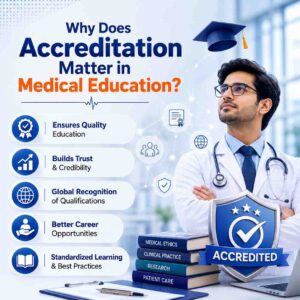
Why Does Accreditation Matter in Medical Education?
Because medicine evolves rapidly, every year brings new clinical guidelines, emerging diseases, treatment protocols, diagnostic technologies, and evidence-based healthcare practices. As a result, graduating with an MBBS degree is only the beginning of a doctor’s professional learning journey.
As a result, continuing medical education enables doctors to maintain clinical competence, improve patient care, and stay aligned with current medical practice.
Accreditation bodies typically evaluate several aspects of a learning program, including:
- Curriculum design
- Learning objectives
- Faculty expertise
- Educational methodology
- Assessment processes
- Continuous quality improvement
For doctors, accreditation provides additional confidence that a fellowship has been designed within an established educational framework rather than solely as a commercial training program.
However, accreditation should always be considered alongside other important factors, including curriculum quality, faculty experience, practical hospital training, learning outcomes, and career relevance.
If you would like to understand another widely used educational framework, read our guide on CPD Accreditation: Why It Matters for Doctors.
Is AACME Accreditation Recognized?
One of the most common questions doctors ask before enrolling in a fellowship is whether its accreditation is recognized and what that recognition actually means. AACME accreditation indicates that a medical fellowship has been developed within an educational framework that emphasizes structured learning, educational planning, and continuous professional development.
However, it is important to distinguish educational accreditation from medical registration, specialist certification, or the legal authority to practice medicine.
Educational accreditation evaluates the quality of a learning program, whereas medical licensing and professional registration remain the responsibility of the relevant regulatory authorities within each country.
Doctors should also evaluate:
- Curriculum quality
- Faculty expertise
- Practical hospital training
- Assessment methodology
- Learning outcomes
- Career relevance
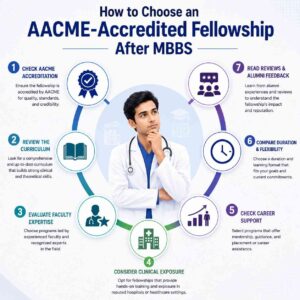
How to Choose an AACME-Accredited Fellowship After MBBS
AACME accreditation helps doctors identify fellowship programs that follow structured educational standards for continuing medical education. However, accreditation should always be evaluated alongside curriculum quality, faculty expertise, practical hospital training, assessment methods, and career relevance before selecting a fellowship after MBBS.
Consider the following factors:
- Whether the curriculum aligns with your clinical interests
- Practical hospital training and hands-on clinical exposure
- Faculty qualifications and teaching experience
- Learning format (online, blended, or hospital-based)
- Assessment methodology and academic support
- Program duration and flexibility for working doctors
- Accreditation and educational quality standards
- Career relevance within your chosen specialty
AACME Accreditation vs CPD Accreditation: What’s the Difference?
When researching fellowship programs, many doctors researching fellowship programs come across both AACME and CPD accreditation and wonder whether they are the same. Although both support continuing medical education, they are separate accreditation frameworks with different educational approaches.
| Feature | AACME | CPD Standards Office (UK) |
| Primary Focus | Continuing Medical Education (CME) | Continuing Professional Development (CPD) |
| Educational Purpose | Improve physician education through structured learning | Support lifelong professional development |
| Intended Audience | Healthcare professionals | Professionals across multiple sectors |
| Educational Framework | Medical education | Professional development |
| Learning Approach | Educational planning, learner outcomes, CME | Ongoing professional learning |
| Supports MBBS Doctors | Yes | Yes |
| Accreditation Scope
Best suited for |
Continuing medical education
Doctors seeking structured CME |
Continuing professional development
Professionals pursuing broader CPD |
Explore AACME-Accredited Medical Fellowships After MBBS
If you are looking for an AACME-accredited fellowship after MBBS, explore Medigrad’s specialty fellowship programs below. Accreditation may vary by program. Review each fellowship page for its accreditation status, curriculum, eligibility, practical hospital training, assessment approach, and learning outcomes before applying.
Fellowship in Emergency Medicine
Fellowship in Echocardiography
Fellowship in Gynaecology & Obstetrics
Why Choose Medigrad for AACME and CPD-Accredited Medical Fellowships?
Choosing the right medical fellowship program involves more than accreditation alone. Doctors should also evaluate curriculum quality, practical hospital training, faculty expertise, learning flexibility, assessment methods, and overall educational outcomes before making a decision.
At Medigrad, our fellowship programs are designed specifically for MBBS doctors and healthcare professionals seeking structured continuing medical education through specialty-focused learning and supervised clinical exposure.
Depending on the program, Medigrad offers fellowships accredited by the American Association of Continuing Medical Education (AACME) and/or The CPD Standards Office (UK).
Alongside accreditation (where applicable), Medigrad emphasizes:
- Specialty-focused medical fellowship curriculum
- Blended learning designed for working doctors
- Practical hospital training through associated hospitals
- Experienced clinician-led faculty
- Interactive academic support and assessments
- Flexible learning without interrupting clinical practice
- Fellowship programs across multiple clinical specialties
AACME accreditation is one indicator of educational quality, but choosing the right fellowship also involves evaluating curriculum, faculty, clinical exposure, learning outcomes, and career relevance. By considering these factors together, MBBS doctors can make informed decisions that support lifelong learning and professional growth.
About the Author
The Medigrad Academic Team creates educational content to help MBBS doctors and healthcare professionals make informed decisions about medical fellowships, continuing medical education (CME), accreditation, and career development. Working with experienced clinicians and medical educators, the team develops accurate, practical, and up-to-date resources based on current medical knowledge and educational standards.
Helpful Questions and Answers – Why AACME Accreditation Matters
-
What is AACME accreditation?
AACME accreditation indicates that a continuing medical education (CME) program has been developed within a structured educational framework that emphasizes educational planning, clearly defined learning objectives, evidence-informed learning, participant evaluation, and continuous professional development. For doctors, it serves as an additional indicator of educational quality when comparing fellowship programs.
-
Why is AACME accreditation important for MBBS doctors?
AACME accreditation helps MBBS doctors identify fellowship programs that follow recognized educational quality standards. For doctors comparing programs, it provides additional confidence that a fellowship has a structured approach to continuing medical education, clinical knowledge enhancement, and lifelong professional development. However, doctors should also evaluate the curriculum, faculty expertise, practical hospital training, and learning outcomes before enrolling.
-
Is AACME accreditation the same as CPD accreditation?
No. AACME and The CPD Standards Office (UK) are different accreditation frameworks. AACME focuses on structured continuing medical education for healthcare professionals, while CPD accreditation supports continuing professional development across multiple professions, including healthcare. Both promote lifelong learning and educational quality, but they serve different educational purposes.
-
How can I verify whether a fellowship is AACME accredited?
Doctors should verify accreditation directly through the educational provider. Review the official fellowship page to check the accreditation status, curriculum, eligibility criteria, practical hospital training, faculty information, learning outcomes, and other program details before applying.
-
How do I choose the right AACME-accredited fellowship after MBBS?
Start by identifying your clinical interests and career objectives. Then compare fellowship programs based on accreditation, curriculum, practical training, faculty expertise, learning outcomes, flexibility, and specialty focus. Choosing a fellowship that combines recognized educational quality with relevant clinical exposure can support long-term professional development.
-
Which Medigrad fellowship programs are AACME accredited?
Selected Medigrad fellowship programs are accredited by the American Association of Continuing Medical Education (AACME). Since accreditation may vary by program, doctors should review the individual fellowship page to confirm the applicable accreditation, curriculum, eligibility, practical hospital training, and learning outcomes before enrolling.

