
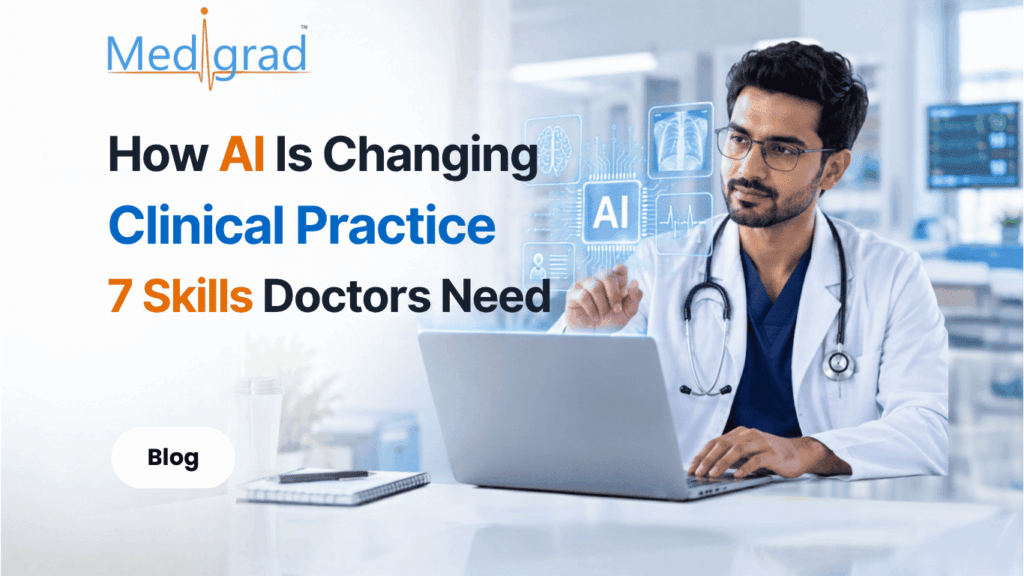
Artificial intelligence is becoming part of modern healthcare through AI-assisted diagnosis, medical imaging, clinical decision-support tools, automated documentation and patient monitoring.
For doctors, the important question is not whether to become an AI expert, but how to use AI effectively while applying sound clinical judgement.
Here are seven skills that will become increasingly important for doctors as AI becomes part of clinical practice.
1. Clinical Decision-Making
AI can identify patterns and provide recommendations, but doctors must decide whether those recommendations fit the individual patient.
Strong clinical decision-making means being able to assess symptoms, history, examination findings and investigations before deciding on diagnosis or treatment.
Doctors should also know when a case requires referral, further investigation or urgent intervention.
2. Evaluating AI-Generated Medical Information
AI can produce inaccurate or incomplete information. Doctors therefore need enough clinical knowledge to question an AI-generated answer rather than accepting it automatically.
Before using an AI recommendation, consider:
- Does it fit the patient’s clinical presentation?
- Is the information supported by reliable evidence?
- Could important information have been missed?
- What are the limitations of the AI tool?
AI literacy should complement clinical knowledge, not replace it.
3. Understanding AI-Assisted Diagnosis
AI is increasingly being applied to areas such as medical imaging, pathology, ECG interpretation and risk prediction.
Doctors do not need to become programmers, but they should understand what an AI tool is designed to do, what data it uses and where it may produce false positives or false negatives.
Doctors should also be aware of algorithmic bias, particularly when an AI system has been developed or validated using data that may not adequately represent the patient population being treated.
Source: Artificial intelligence in clinical practice
4. Managing Complex Patients
AI can process information quickly, but patients often have multiple conditions that require clinical prioritization.
An MBBS doctor managing a patient with diabetes, hypertension and cardiovascular risk, for example, needs to understand how these conditions interact and how treatment decisions affect the patient as a whole.
Specialty-focused fellowship courses after MBBS can help doctors build deeper clinical knowledge in a specific area of practice.
5. Knowing the Limits of AI
AI tools can perform differently across clinical situations and patient populations. Doctors therefore need to understand when an AI output requires verification or should not be used.
Doctors should therefore know:
- When an AI recommendation requires verification
- When clinical assessment should take priority
- When a patient needs specialist referral
- When an AI tool should not be used
Understanding these limitations is an essential part of responsible AI use.
6. Protecting Patient Data
AI systems often rely on large amounts of medical information, making privacy and data security important considerations.
Doctors using AI-based tools should understand how patient information is collected, processed and stored and whether the tool is appropriate for clinical use.
Patient privacy should remain a priority regardless of the technology being used.
Source: Ethics and governance of artificial intelligence for health
7. Communicating AI-Assisted Decisions
Patients may increasingly ask doctors whether AI was involved in their diagnosis or treatment.
Doctors should be able to explain the role of AI clearly, including what the technology contributed and why the final clinical decision was made.
Technology should support the doctor-patient relationship rather than make communication more complicated.
What Does AI Mean for Doctors Pursuing Fellowship Courses After MBBS?
AI does not reduce the importance of specialty knowledge. In many cases, stronger clinical knowledge helps doctors evaluate AI-assisted information more effectively.
For doctors considering fellowship after MBBS, specialty-focused education can provide deeper knowledge in a particular area of clinical practice. The right choice depends on your specialty interest, existing experience and professional goals.
Depending on their interests, doctors can explore areas such as:
- Fellowship in Cardiology
- Fellowship in Diabetology
- Fellowship in Emergency Medicine
- Fellowship in Critical Care Medicine
- Fellowship in Internal Medicine
- Fellowship in Family Medicine
- Fellowship in Pediatrics
- Fellowship in Neonatology
- Fellowship in Gynaecology & Obstetrics
- Fellowship in Infectious Diseases
- Fellowship in Echocardiography
Frequently Asked Questions
Do Doctors Need to Learn AI?
Doctors do not need programming skills to work with AI in healthcare. However, they should understand how AI tools are used, evaluate their outputs critically and recognize their limitations.
How is AI changing the role of doctors?
AI is helping doctors with tasks such as analyzing medical data, supporting diagnosis, summarizing information and monitoring patients. Doctors still need to interpret these outputs and apply them to the individual patient’s clinical situation.
What AI skills should doctors learn?
Doctors should develop basic AI literacy, critical evaluation skills, understanding of AI-assisted diagnosis, data privacy awareness and the ability to recognize when AI outputs need clinical verification.
Can doctors rely on AI for diagnosis?
AI can support diagnostic assessment, but doctors should not rely on AI output without considering the patient’s history, examination, investigations and clinical context. AI-generated recommendations may contain errors or limitations.
Will AI replace doctors in the future?
AI is likely to change many tasks performed by doctors rather than eliminate the need for doctors. Clinical reasoning, patient communication, decision-making and professional responsibility remain important parts of medical practice.
How can MBBS doctors prepare for AI-driven healthcare?
MBBS doctors can build strong specialty knowledge, stay updated with evidence-based medicine, develop basic AI literacy and learn how to critically evaluate technology-assisted clinical decisions.
What are the limitations of AI in clinical practice?
AI systems can produce inaccurate outputs, reflect biases in their training data and perform differently across clinical situations. Doctors should therefore verify AI-assisted information and apply it within the context of the individual patient.

