
Emergency Medicine and Critical Care Medicine are two rapidly growing specialties for MBBS doctors. Both involve managing critically ill patients, making rapid clinical decisions, and working in high-pressure hospital environments. Because both specialties often care for the same patients at different stages of treatment, many MBBS doctors are unsure which fellowship best aligns with their career goals.
While both specialties require strong clinical skills and the ability to respond quickly to life-threatening conditions, their focus, patient journeys, work environments, and long-term career paths differ significantly.
Key Highlights
- Compare Emergency Medicine vs Critical Care after MBBS.
- Learn how the two specialties differ in patient care and work settings.
- Understand practical training, duration, and career pathways.
- Identify which fellowship matches your clinical interests.
- Make an informed career decision based on your long-term goals.
Understanding the Growing Need for Emergency and Critical Care Specialists
According to the World Health Organization (WHO), effective emergency care systems can address more than 50% of deaths and over one-third of the disease burden in low- and middle-income countries by providing timely treatment for acute illnesses and injuries.
In India, the demand for emergency and critical care specialists continues to increase due to the rising burden of cardiovascular diseases, stroke, sepsis, respiratory illnesses, trauma, poisoning, and other medical emergencies. According to the Ministry of Road Transport and Highways (MoRTH), 1,77,177 people lost their lives in road accidents in 2024, illustrating just one category of patients requiring immediate emergency care.
At the same time, hospitals are witnessing a growing number of critically ill patients who require intensive monitoring, ventilatory support, organ support, and multidisciplinary ICU management. Together, these trends have increased the demand for MBBS doctors with structured training in emergency assessment, resuscitation, and intensive care management.
Emergency Medicine vs Critical Care: Quick Comparison
The table below summarizes the key differences between Emergency Medicine vs Critical Care Medicine fellowship, helping you compare their clinical focus, work environment, practical training, and career pathways at a glance.
| Feature | Emergency Medicine | Critical Care |
|---|---|---|
| Focus | Initial emergencies | ICU care |
| Patients | Acute illness & trauma | Critically ill |
| Workplace | Emergency Department | ICU |
| Role | Stabilization | Ongoing care |
| Duration | 12 Months | 12 Months |
| Training | 3 Months | 8 Weeks |
| Mode | Blended | Blended |
| Eligibility | MBBS | MBBS & Above |
| Key Skills | Trauma, ACLS, Airway | Ventilation, ICU Support |
| Best For | Emergency care | ICU practice |
| Bonus | NHS/FICM e-ICM | CPD (UK) & AACME Accredited |
Emergency Medicine vs Critical Care: Understanding the Difference
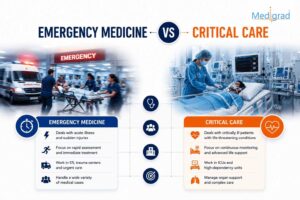
Although Emergency Medicine and Critical Care Medicine often work together in managing the same patient, they are not the same specialty. Emergency physicians focus on the rapid assessment, stabilization, and initial management of acute illnesses and injuries, while critical care physicians provide ongoing treatment for patients requiring intensive monitoring and organ support in the ICU. Understanding this distinction is essential before choosing the fellowship that best aligns with your career goals.
Emergency Medicine begins when a patient first presents to the emergency department. The goal is to rapidly assess, stabilize, diagnose, and initiate treatment before deciding whether the patient can be discharged, admitted to a ward, or transferred to the ICU.
Critical Care Medicine begins after the patient has been identified as critically ill and requires continuous monitoring, advanced life support, and specialized ICU management.
A simple way to understand the distinction is:
- Emergency Medicine: “Save the patient during the first critical hours.”
- Critical Care: “Keep the patient alive and support recovery over the following days.”
Which Fellowship Should You Choose?
The right fellowship depends on your clinical interests, preferred work environment, and long-term career goals.
Choose a Fellowship in Emergency Medicine if you:
- Prefer fast-paced clinical decision-making.
- Want to manage trauma, accidents, poisoning, and medical emergencies.
- Like working in emergency departments.
- Prefer handling a wide variety of acute clinical cases.
- Want extensive exposure to emergency procedures and patient stabilization.
Choose a Fellowship in Critical Care Medicine if you:
- Prefer managing critically ill patients over several days.
- Want to develop expertise in ICU care and organ support.
- Are interested in mechanical ventilation and advanced patient monitoring.
- Prefer systematic clinical decision-making with multidisciplinary teams.
- Plan to build expertise in intensive care medicine.
Still deciding which fellowship is right for you? Both Medigrad fellowship programs are designed specifically for working MBBS doctors and above, combining 12 months of blended learning with supervised hospital training. The Fellowship in Emergency Medicine includes 3 months of practical hospital training, while the Fellowship in Critical Care Medicine includes 8 weeks of clinical training focused on ICU-based patient management. Both programs allow doctors to continue clinical practice while upgrading their skills through flexible learning.
Common Mistakes Doctors Make While Choosing Between the Two
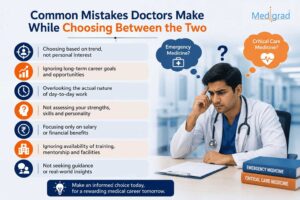
Many doctors choose a fellowship based only on popularity or course fees. However, selecting the right program requires evaluating several important factors.
Before enrolling, consider:
- Your preferred clinical work environment (Emergency Department vs ICU)
- Curriculum depth and learning outcomes
- Duration of the program
- Practical hospital training opportunities
- Faculty expertise
- Accreditation and institutional credibility
- Flexibility for working doctors
- Alignment with your long-term career goals
Choosing a fellowship that matches your interests and clinical aspirations is more valuable than simply selecting the shortest or least expensive program.
Why Choose Medigrad for Emergency or Critical Care Training?
For doctors looking to upskill without interrupting clinical practice, Medigrad offers structured fellowship programs designed around the needs of working MBBS doctors.
Key features of Medigrad’s fellowship programs include:
- 12-month blended learning format
- Flexible online academic modules
- Practical hospital training through associated hospitals
- Experienced clinician-led faculty
- Evidence-based curriculum
- Interactive learning sessions and assessments
- Flexible learning designed for working doctors
Whether you choose Emergency Medicine or Critical Care Medicine, Medigrad’s blended fellowship programs combine flexible online learning with supervised hospital training to help MBBS doctors build practical clinical confidence alongside academic knowledge.
Frequently Asked Questions
Which fellowship is better after MBBS: Emergency Medicine or Critical Care?
The right fellowship depends on your career goals. Choose Emergency Medicine if you want to manage acute emergencies and trauma in the emergency department. Choose Critical Care Medicine if you want to care for critically ill patients requiring advanced monitoring and organ support in the ICU.
Can I work in an ICU after completing an Emergency Medicine fellowship?
Many emergency physicians collaborate closely with ICU teams and manage critically ill patients during initial stabilization. However, responsibilities may vary depending on hospital policies, clinical experience, and local regulations.
Is Critical Care more difficult than Emergency Medicine?
Both specialties are clinically demanding but in different ways. Emergency Medicine requires rapid assessment and decision-making across a broad range of conditions, whereas Critical Care focuses on prolonged management of patients with life-threatening illnesses requiring intensive monitoring.
Which fellowship offers more practical exposure?
Practical training varies between institutions. Doctors should compare the curriculum, duration of hospital postings, and learning model before selecting a program.
Can working doctors pursue these fellowships?
Yes. Many fellowship programs use blended learning models that allow doctors to continue practicing while completing their academic training.
About the Author
The Medigrad Academic Team creates educational content to support MBBS doctors and healthcare professionals in their learning journey. Working with experienced clinicians and medical educators, the team develops accurate, practical, and up-to-date resources based on current medical knowledge and clinical practice.
References
World Health Organization (WHO). Emergency Care. https://www.who.int/health-topics/emergency-care
Ministry of Road Transport and Highways (MoRTH). Road Accidents in India 2024. https://morth.nic.in/

