
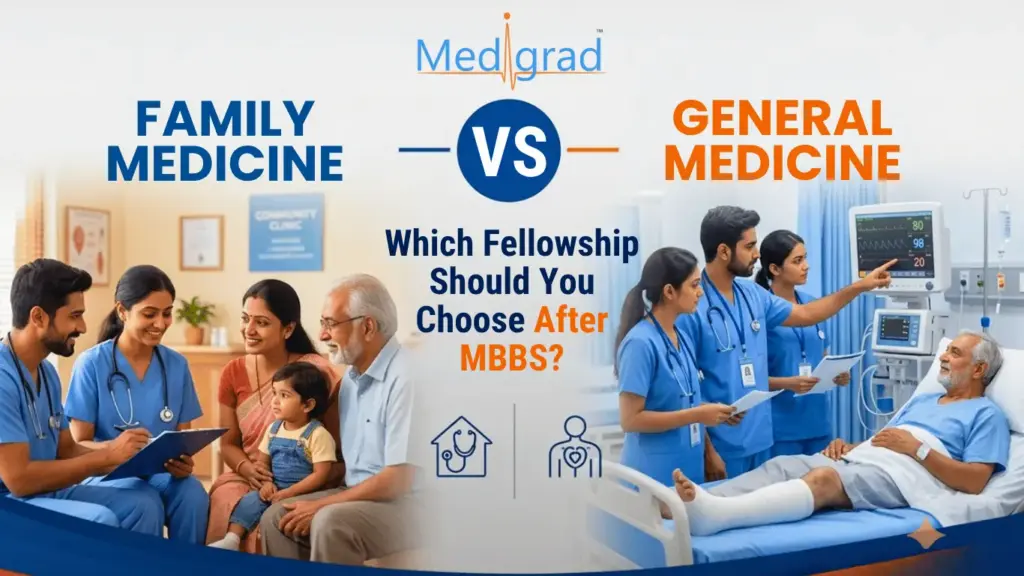
Family Medicine and General Medicine are closely related but distinct medical specialties. Both involve diagnosing and managing a broad range of health conditions, but they differ in their patient population, training focus, clinical practice and career pathways.
For MBBS doctors considering specialization after MBBS, understanding these differences can help clarify which type of medical practice matches their professional interests.
Family Medicine vs General Medicine: Quick Comparison
| Factor | Family Medicine | General Medicine |
| Main patient group | All age groups | Primarily adults |
| Main focus | Comprehensive and continuing care | Adult medical diagnosis and management |
| Preventive care | Strong focus | Important part of adult healthcare |
| Chronic diseases | Commonly managed | Commonly managed |
| Pediatric care | Included | Not the primary focus |
| Primary care | Central to the specialty | May be provided in outpatient settings |
| Complex adult disease | Managed according to training and setting | Major area of practice |
| Common settings | Clinics, primary care, community and hospital settings | Hospitals, medical departments and outpatient clinics |
There is considerable overlap between the two. The difference is mainly in the population served and the approach to patient care.
Family Medicine vs General Medicine: Training Differences
The two specialties require broad clinical knowledge, but their training emphasis differs.
Family Medicine Training
Training is designed around comprehensive care across the lifespan and can include exposure to:
- Adult medicine
- Pediatrics
- Women’s health
- Preventive medicine
- Community healthcare
- Chronic disease management
- Emergency care
- Geriatric care
- Mental health
- Primary care
The goal is to develop a physician capable of managing a wide range of healthcare needs and identifying when specialist referral is appropriate.
General Medicine Training
Training focuses primarily on adult medicine and complex clinical decision-making.
It develops skills in:
- Clinical diagnosis
- Differential diagnosis
- Investigation and interpretation
- Acute medical care
- Chronic disease management
- Multisystem conditions
- Inpatient medicine
- Outpatient medicine
- Coordination with medical subspecialties
The National Medical Commission recognizes MD Family Medicine and MD General Medicine as separate postgraduate broad-specialty qualifications. (NMC)
How Does Their Clinical Practice Differ?
The two specialties can manage many of the same conditions, but their clinical context may differ.For example, diabetes can be managed by both Family Medicine and General Medicine doctors.
A Family Medicine doctor may manage diabetes as part of a patient’s broader long-term healthcare, including preventive care, lifestyle counselling and other family or age-related health needs.
A General Medicine physician may manage diabetes alongside complex adult conditions, complications or multiple comorbidities.
Similarly, both specialties may manage hypertension, infections and respiratory conditions.
Therefore, it is not accurate to divide diseases into a strict “Family Medicine list” and “General Medicine list.” Clinical responsibilities depend on the doctor’s training, competence, workplace and applicable professional requirements.
Where Do Family Medicine Doctors Work?
Family Medicine doctors may work in:
- Primary-care clinics
- Family practices
- Community healthcare settings
- Outpatient clinics
- Hospitals
- Integrated healthcare systems
- Preventive healthcare services
A major feature of Family Medicine is continuity—patients may return to the same physician for different healthcare needs over time.
Where Do General Medicine Doctors Work?
General Medicine physicians commonly work in:
- Hospitals
- Internal Medicine departments
- Outpatient departments
- Multispecialty hospitals
- Medical clinics
- Inpatient services
- Consultation services
Their work may involve evaluating complex adult medical presentations and coordinating with subspecialists.
Family Medicine vs General Medicine After MBBS
For doctors considering what to do after MBBS, Family Medicine and General Medicine offer different clinical directions and areas of focus.
| Family Medicine | General Medicine |
| Primary care | Adult medicine |
| Comprehensive healthcare | Complex medical conditions |
| Patients across different age groups | Multisystem diseases |
| Preventive medicine | Clinical diagnosis and management |
| Long-term patient relationships | Hospital-based practice |
| Community-based healthcare | Inpatient and outpatient adult care |
Is General Medicine the Same as Internal Medicine?
In India, MD General Medicine is the formal postgraduate specialty name. The discipline is commonly known as Internal Medicine in many other healthcare systems.
The terms can therefore appear interchangeably in medical discussions, but doctors should look at the actual qualification and applicable regulatory framework rather than relying only on job titles such as “general physician” or “internal medicine doctor.”
Is Family Medicine the Same as General Practice?
Not necessarily. General Practice generally refers to broad first-contact medical practice, while Family Medicine is a defined medical specialty with structured training.
The terminology can vary between countries, so the qualification and training behind a doctor’s professional title are important.
Medigrad Fellowship for Doctors
For doctors looking to build additional clinical knowledge after MBBS, Medigrad offers fellowship and certification programs across selected medical disciplines. These programs are designed to provide focused education in specific areas of clinical practice.
Depending on the program, Medigrad courses may combine online medical education with practical or hospital-based training, where applicable. Doctors can explore focused learning areas such as Family Medicine, Cardiology, Critical Care Medicine, Diabetology, Emergency Medicine and other clinical disciplines.
Important: Medigrad fellowships are educational programs and should not be considered a substitute for FMGE, medical registration, or a recognized MD/MS/DNB qualification.
Frequently Asked Questions
What is the difference between Family Medicine and General Medicine?
Family Medicine focuses on comprehensive care across age groups, while General Medicine primarily focuses on adult medical conditions and complex medical management.
Is Family Medicine the same as General Medicine?
No. They are distinct medical specialties, although there is considerable overlap in the conditions they manage.
Is General Medicine the same as Internal Medicine?
In India, MD General Medicine is the formal postgraduate specialty designation. The field is commonly referred to as Internal Medicine internationally.
Can Family Medicine doctors treat adults?
Yes. Adult healthcare is an important part of Family Medicine, along with care for other age groups.
Can Family Medicine doctors treat children?
Family Medicine is designed around care across the lifespan, although the specific scope of pediatric care depends on training, clinical setting and applicable requirements.

