
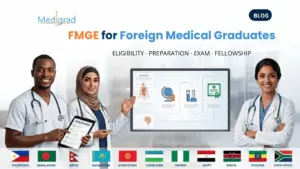
Completed your medical degree outside India and planning to practice medicine in India? Before you start preparing for the Foreign Medical Graduate Examination (FMGE), there are several things you should understand about your eligibility, documents, application, examination, registration pathway and career options after the exam.
For a foreign medical graduate, the process can be confusing. You may have completed an MBBS or equivalent medical qualification in the Philippines, Bangladesh, Nepal, Kazakhstan, Kyrgyzstan, Uzbekistan, Nigeria, Egypt, Kenya, Ethiopia, South Africa or another country, but your next step depends on more than the country where you studied.
You need to understand whether the FMGE pathway applies to you, whether your primary medical qualification meets the applicable requirements, what documents you need, how the examination works, how much preparation time you may need, and what happens after you pass.
This guide brings those steps together in one place.
What Is FMGE?
FMGE stands for Foreign Medical Graduate Examination. It is a screening examination conducted by the National Board of Examinations in Medical Sciences (NBEMS) for eligible foreign medical graduates seeking the applicable pathway toward medical registration in India.
The examination is not a postgraduate degree and does not make a doctor an MD, MS or DNB specialist. Instead, it forms part of the regulatory pathway for eligible foreign medical graduates seeking to proceed toward medical registration in India.
The current regulatory framework for foreign medical graduates is governed by NMC regulations, including the Foreign Medical Graduate Licentiate Regulations, 2021, along with subsequent applicable notifications and guidance.
Before Preparing for FMGE: Check These 7 Things
Before paying for preparation resources or building a six-month study plan, check the fundamentals.
- What is your nationality or status?
Determine whether the FMGE pathway applicable to you is based on Indian citizenship, OCI status, or another category.
- Where did you obtain your primary medical qualification?
Identify the exact institution, country and qualification awarded.
- Does your qualification meet the applicable requirements?
Do not assume that every overseas medical degree automatically satisfies Indian regulatory requirements.
- When did you start and complete your medical education?
The applicable rules can depend on dates and regulatory provisions.
- Have you completed the required medical training?
Check the applicable requirements relating to your course and clinical training.
- Do you need an Eligibility Certificate?
The requirement depends on the candidate and applicable regulations. NMC has issued guidance stating that candidates who are required to possess an Eligibility Certificate cannot apply for the FMGE Screening Test without it.
- Have you checked the latest NBEMS Information Bulletin?
This is one of the most important steps.
FMGE Eligibility: What Does a Foreign Medical Graduate Need?
Eligibility should be checked against the regulations and the Information Bulletin applicable to your examination session.
Depending on the candidate and regulatory category, important considerations can include:
- Indian citizenship or OCI status where applicable
- A recognized primary medical qualification obtained outside India
- Completion of the final medical qualification by the applicable cut-off date
- Required documentary evidence
- Applicable NMC Eligibility Certificate requirements
- Verification/authentication requirements
- Compliance with applicable foreign medical graduate regulations
NMC’s foreign medical graduate framework also contains requirements concerning the structure and duration of medical education and clinical training. The current regulations should be reviewed rather than relying on simplified eligibility lists published by coaching websites.
Do You Need an NMC Eligibility Certificate?
This is another area where foreign medical graduates often receive conflicting information. An Eligibility Certificate is not something every candidate should automatically assume is required in the same way.
NMC has issued specific guidance regarding candidates who are required to possess an Eligibility Certificate and has also clarified categories for which the requirement may differ.
Before applying, check:
- Whether your category requires an Eligibility Certificate
- Whether you already have one
- Whether your certificate details match your qualification
- Whether additional documentation is required
- Whether your current FMGE Information Bulletin specifies any additional requirements
FMGE Documents: What Should You Prepare?
Your exact document requirements should always be checked against the current NBEMS application instructions.
However, it is sensible to organize your documentation well before the application window.
Academic documents
Keep accessible copies of:
- Primary medical qualification
- Degree certificate
- Academic records/marksheets
- Transcripts where applicable
- Internship or clinical-training documentation
- Other university-issued documents requested by the authorities
Identity documents
Depending on the current application requirements:
- Passport
- Citizenship/OCI documentation where applicable
- Other prescribed identity documents
Regulatory documents
Where applicable:
- NMC Eligibility Certificate
- Qualification verification documents
- Registration/licensing documents
- Other certificates requested by NBEMS/NMC
Digital copies
Maintain clear digital copies of the documents that may need to be uploaded.
Check:
- File format
- File size
- Image quality
- Name consistency
- Document validity
A simple document folder can save considerable stress when the application window opens.
FMGE Exam Pattern
The FMGE is a computer-based examination consisting of 300 multiple-choice questions.
The examination is divided into two parts of 150 questions each, with a total examination time of five hours. Current published FMGE information describes each part as 150 questions with 2.5 hours allotted to each part.
The examination is conducted in English. The current qualifying requirement is 150 marks out of 300, equivalent to 50%, under the applicable screening-test framework.
What Subjects Are Tested in FMGE?
The FMGE blueprint covers major areas of the medical curriculum.
Pre- and para-clinical areas
These include subjects such as:
Anatomy, Physiology, Biochemistry, Pathology, Microbiology, Pharmacology, Forensic Medicine
Clinical areas
These include major clinical disciplines and allied subjects such as:
Medicine, Psychiatry, Dermatology and sexually transmitted diseases, Radiotherapy, Surgery, Anesthesiology, Orthopedics, Radiodiagnosis, Pediatrics, Ophthalmology, Otorhinolaryngology, Obstetrics and Genecology, Community Medicine
*The published FMGE blueprint allocates a larger proportion of marks to clinical subjects than to the pre- and para-clinical group.
How Many Months Do You Need to Prepare for FMGE?
Most candidates should plan 3 to 12 months for FMGE preparation, depending on their medical-school foundation, previous attempts, and the amount of time they can study each day.
There is no officially prescribed preparation period. FMGE is a 300-question examination, and candidates need to meet the prescribed passing standard in the current NBEMS examination. Preparation should therefore focus on completing the syllabus, solving questions, identifying weak subjects, and revising multiple times.
What If You Have Failed FMGE Before?
A previous unsuccessful attempt can actually make your next preparation more focused—if you analyze what went wrong.
Ask yourself:
Was the problem knowledge?
Was the problem revision?
Was the problem question practice?
Was the problem time management?
Was the problem examination anxiety?
Find the reason for the previous result first.
FMGE vs NEET-PG: They Are Not the Same
Foreign medical graduates sometimes confuse these examinations because both appear in discussions about medical careers in India.
They serve different purposes.
| FMGE | NEET-PG |
| Screening examination for eligible foreign medical graduates | Postgraduate medical entrance examination |
| Associated with the pathway toward medical registration | Used for admission to postgraduate medical education under the applicable system |
| Relevant to foreign medical graduates who fall within the FMGE framework | Relevant to candidates seeking postgraduate medical education |
| Not a postgraduate degree | Entrance examination for postgraduate medical training |
Passing FMGE does not mean that you have completed postgraduate specialization.
Can an FMGE-Qualified Doctor Do a Fellowship?
Yes, an eligible doctor may consider a fellowship or certification program as part of additional medical education.
But keep the distinction clear:
FMGE → regulatory pathway
Medical registration → permission to practice subject to applicable rules
Fellowship → additional focused education/clinical training
A fellowship does not replace the requirements for medical registration.
It also should not be represented as equivalent to MD, MS or DNB.
Medigrad Fellowships for Foreign Doctors
Medigrad is a medical education organization offering fellowship and certification programs for doctors across selected clinical disciplines. For foreign medical graduates and doctors, these programs can provide structured learning opportunities in areas such as cardiology, critical care, internal medicine, diabetology, emergency medicine, and other clinical disciplines.
Depending on the individual program, Medigrad can combine online medical courses with practical or hospital-based training, where applicable. Eligibility, course duration, learning format, and practical training opportunities vary by program.
Foreign doctors should review the specific fellowship eligibility criteria and ensure that their FMGE, medical registration, licensing, and other regulatory requirements are addressed separately where applicable.
Medigrad fellowships are educational programs and should not be considered a substitute for the FMGE, medical registration, or a recognized MD/MS/DNB qualification.
- Diabetology
- Cardiology
- Preventive Cardiology
- Internal Medicine
- Critical Care Medicine
- Emergency Medicine
- Family Medicine
- Neonatology
- Pediatrics
- Gynaecology & Obstetrics
- Echocardiography
- Medical Emergencies
Frequently Asked Questions About FMGE
Is FMGE compulsory for every doctor who studied abroad?
No. The requirement depends on the candidate’s nationality/status, qualification and applicable regulations. Do not determine FMGE eligibility only by the country where you studied.
Can a non-Indian foreign doctor take FMGE?
Do not assume that all foreign nationals are eligible under the same FMGE pathway as Indian citizens or OCI candidates. Check the current NMC and NBEMS requirements applicable to your circumstances.
What countries do FMGE candidates commonly come from?
Candidates may have studied medicine in countries across Asia, Central Asia, Europe/Eurasia, Africa and the Middle East. Examples include the Philippines, Bangladesh, Nepal, China, Russia, Ukraine, Georgia, Kazakhstan, Kyrgyzstan, Uzbekistan, Nigeria, Kenya, Ethiopia, Egypt and others.
How many months should I prepare for FMGE?
There is no fixed number of months. Six months may be reasonable for some candidates, while others may need three, nine or twelve months depending on their academic foundation and previous preparation.
What if I fail FMGE?
Review why you did not qualify, identify your weak areas and build a new preparation strategy. NMC’s published FAQ states that there is no restriction on the number of attempts, subject to applicable eligibility requirements.
Is FMGE the same as NEET-PG?
No. FMGE is associated with the foreign medical graduate screening/registration pathway, while NEET-PG is associated with postgraduate medical admissions.

