
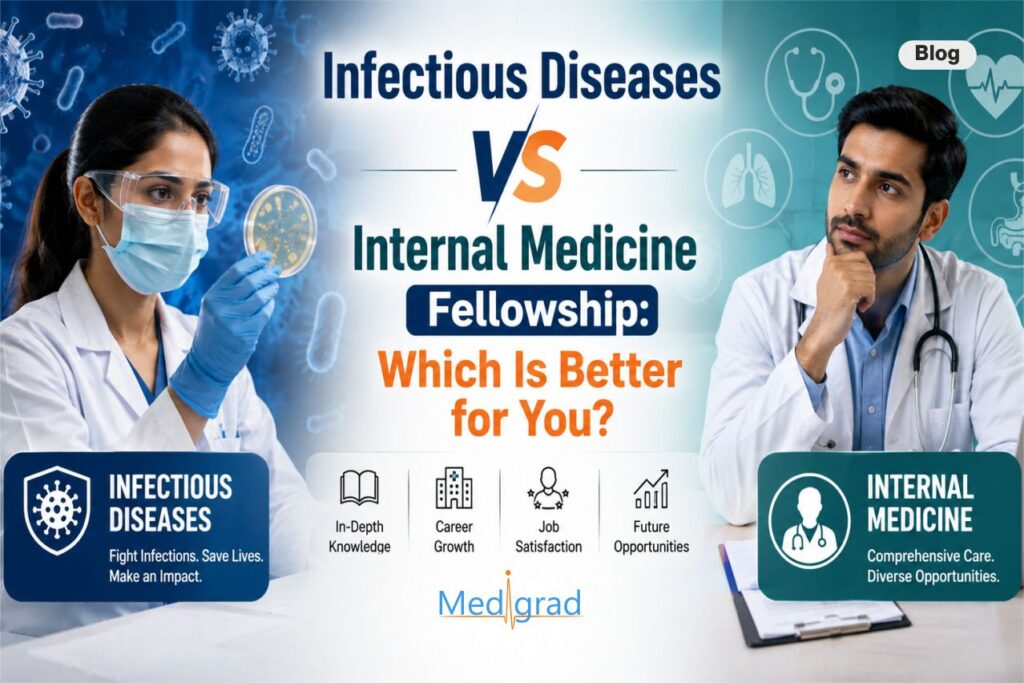
Infectious Diseases and Internal Medicine overlap in clinical practice, but they differ significantly in scope. Internal Medicine focuses on the comprehensive diagnosis and management of adult patients across multiple organ systems, while Infectious Diseases focuses specifically on infections caused by bacterial, viral, fungal, parasitic and other pathogens.
The two learning paths therefore differ in clinical focus, breadth and the type of expertise they are designed to develop.
Infectious Diseases vs Internal Medicine: Quick Comparison
| Factor | Infectious Diseases | Internal Medicine |
| Primary focus | Diagnosis, treatment and prevention of infectious diseases | Diagnosis and management of adult medical conditions |
| Scope | Focused | Broad |
| Major areas | Bacterial, viral, fungal, parasitic and mycobacterial infections | Cardiovascular, respiratory, renal, endocrine, gastrointestinal, neurological and other adult conditions |
| Clinical perspective | Infection-focused | Multisystem and whole-patient |
| Diagnostic emphasis | Identifying and managing infectious causes | Evaluating complex and multiple medical conditions |
| Relationship | Focused infection-related expertise | Broad field encompassing multiple medical subspecialties |
What Does an Infectious Diseases Fellowship Focus On?
An Infectious Diseases Fellowship focuses on the diagnosis, treatment and prevention of bacterial, viral, fungal, parasitic and mycobacterial infections, along with antimicrobial management and infection prevention.
The World Health Organization (WHO) reports that bacterial antimicrobial resistance was associated with more than 4.7 million deaths globally in 2021, while approximately 1 in 6 laboratory-confirmed bacterial infections were resistant to antibiotics in 2023. [Source: WHO 2023]
What Does an Internal Medicine Fellowship Focus On?
An Internal Medicine Fellowship has a broader adult-medicine focus, covering conditions across cardiovascular, respiratory, renal, gastrointestinal, endocrine, neurological and infectious diseases.
A 2025 BMJ Public Health analysis of WHO-SAGE Wave 2 India data found a 45.14% prevalence of multimorbidity among the analyzed adults aged 50 and above, with hypertension and arthritis among the most common conditions. [Source: BMJ Public Health 2025]
Which Is Broader: Infectious Diseases or Internal Medicine?
Internal Medicine is broader. It covers multiple organ systems and adult medical conditions, while Infectious Diseases has a more focused scope around infectious conditions and their management.
Doctors comparing specialty-focused learning pathways may also want to understand how fellowships can support their broader clinical career development. Learn more about how post-MBBS fellowships can support doctors’ clinical career development and explore factors to consider when choosing a fellowship pathway.
How Do Medigrad’s Infectious Diseases and Internal Medicine Fellowships Differ?
Medigrad offers both programs, but their learning structure and clinical scope are different.
The Fellowship in Infectious Diseases is a 12-month online program focused specifically on infectious diseases. Its curriculum includes infectious-disease fundamentals, bacterial infections, viral infections, protozoal infections and helminthic diseases.
The Fellowship in Internal Medicine is also a 12-month program, but it includes 8 weeks of training at partnered hospitals. Its curriculum covers a broader range of adult medicine, including cardiovascular, respiratory, gastrointestinal, renal, neurological, endocrine and other systemic conditions.
Therefore, the difference is not simply the course duration—both programs run for 12 months—but the clinical scope and learning structure. Infectious Diseases provides a more focused subject area, whereas Internal Medicine covers a wider range of adult medical conditions.
Doctors exploring broader professional development options can also explore courses for doctors after MBBS, including fellowship and specialty-focused learning pathways.
Medigrad Program Comparison
| Feature | Fellowship in Infectious Diseases | Fellowship in Internal Medicine |
| Duration | 12 months | 12 months |
| Learning format | Online | Online program with 8 weeks of partnered-hospital training |
| Clinical scope | Focused infectious diseases | Broad adult medicine |
| Major curriculum focus | Bacterial, viral, protozoal, helminthic and other infectious diseases | Multiple adult medical systems and conditions |
| Training component | Online learning | Online + 8 weeks of partnered-hospital training |
Infectious Diseases vs Internal Medicine: Which Is the Better Fit?
Infectious Diseases is the more focused pathway for doctors who want deeper knowledge of infections, infectious-disease diagnosis, antimicrobial management, epidemiology and prevention.
Internal Medicine provides broader exposure to adult medical conditions across multiple organ systems and may be more suitable for doctors seeking wider adult-medicine knowledge.
Explore the Fellowship in Infectious Diseases or Fellowship in Internal Medicine to review the curriculum, learning structure and training details.
About the Author
Medigrad Medical Education Team develops educational content for doctors exploring fellowship and continuing medical education pathways after MBBS. The team focuses on medical education, clinical learning pathways and evidence-based information to help doctors compare professional development options.
FAQs: Infectious Diseases vs Internal Medicine Fellowship
1. Is Infectious Diseases or Internal Medicine broader?
Internal Medicine is broader. It covers a wide range of adult medical conditions across multiple organ systems, whereas Infectious Diseases has a more focused scope around infections, infectious organisms, antimicrobial management and prevention.
2. How is an Infectious Diseases Fellowship different from an Internal Medicine Fellowship?
The main difference is clinical focus. Infectious Diseases concentrates on diagnosing, treating and preventing infections, while Internal Medicine develops broader knowledge for assessing and managing multiple adult medical conditions.
3. Which is more focused on infection management?
Infectious Diseases is more specifically focused on infection management, including bacterial, viral, fungal, parasitic and mycobacterial diseases, antimicrobial use and infection prevention.
4. Which fellowship provides broader adult-medicine knowledge?
Internal Medicine provides broader adult-medicine exposure, covering areas such as cardiology, respiratory medicine, gastroenterology, nephrology, endocrinology, neurology and infectious diseases.
5. Can Infectious Diseases and Internal Medicine overlap?
Yes. Infectious Diseases is closely connected with Internal Medicine, because infections frequently occur alongside conditions such as diabetes, kidney disease, cardiovascular disease and other systemic illnesses. The difference is that Infectious Diseases develops greater depth in infection-related problems, while Internal Medicine takes a broader multisystem approach.
6. Which should I choose if I mainly manage patients with infections?
If infections are the main area you want to develop, an Infectious Diseases-focused learning pathway may be more relevant. If you want to manage a wider range of adult medical conditions alongside infections, Internal Medicine may be a better fit.
7. Does Medigrad’s Internal Medicine Fellowship include infectious diseases?
Yes. Infectious diseases form part of the broader adult-medicine scope of Internal Medicine, alongside areas such as cardiovascular, respiratory, renal, gastrointestinal, endocrine and neurological medicine.

